Worked solutionOne step at a time
Count the space
Every position can hold any of the 20 amino acids, independently. With 92 designed positions the count multiplies by 20 ninety-two times.
Compare it with something physical
The observable universe holds on the order of 10⁸⁰ atoms. Sequence space for one small protein is about 10³⁹ times larger than that.
Give brute force the best case
Test a billion candidate sequences every second, and start at the Big Bang: 13.8 billion years is 4.35 × 10¹⁷ seconds.
So do not search sequences, search within one shape
Fix the target: a backbone blueprint, the exact fold you want. For Top7 that was a five-strand sheet packed against two helices, a topology nature had not used. Now the question is no longer "which of 10¹¹⁹ sequences folds into something?" but "which amino acid is lowest in energy at this position on this fixed backbone, given its neighbours?" That question is local, and it is answered position by position, cycling over positions until the sequence and the energy settle.
Answer: B, shape first, then letters
Kuhlman et al. alternated sequence design on a fixed backbone with backbone refinement, using Rosetta's physical energy function, and iterated until the design converged. The crystal structure of the resulting 92-residue protein matched the blueprint. The modern version of the same step is inverse folding with a neural network such as ProteinMPNN: again the structure is the input and the sequence is the output.
What the computation showedNumbers from the reel's code
The reel reads the 1QYS PDB file and computes every number it shows.
- SEQRES lists 106 residues: a Met-Gly expression start, the 92 designed residues (DIQVQ...VEGQL), and a 12-residue Glu-Gly-Gly-Ser-Leu-Glu-His6 purification tag. The designed length used throughout is 92, and all 92 are resolved in the crystal structure (residue 37 is selenomethionine, stored as HETATM MSE).
- 20⁹² is evaluated as an exact integer: 4.95 × 10¹¹⁹, 120 digits long.
- Secondary structure from the PDB records: 37 residues in helices, 37 in strands, the rest loop.
- Brute force budget: 10⁹ per second × 4.3549 × 10¹⁷ s = 4.35 × 10²⁶ tested, a fraction 8.8 × 10⁻⁹⁴ of the space, one part in 1.1 × 10⁹³.
Wrong answersWhy each one is tempting
| Pick | What went wrong |
|---|---|
| A · screen faster | Treats a gap of 93 orders of magnitude as an engineering problem. No speed-up of a random search over 10¹¹⁹ sequences matters. |
| C · copy nature | Top7's fold was deliberately one nature has not produced, so there was nothing to copy. |
| D · lab evolution | Selection improves what already works a little. Random 92-residue sequences essentially never fold, so there is no gradient to climb. |
Follow-ups an interviewer asks nextTry these before opening them
Why does fixing the backbone make the search tractable?
On a fixed backbone the energy is close to a sum of local terms: each side chain interacts with its neighbours in space, not with all 91 others. That turns a global search into many small, coupled choices, solved by iterating over positions (Monte Carlo with simulated annealing in Rosetta) rather than enumerating sequences.
How many sequences fold into a given shape?
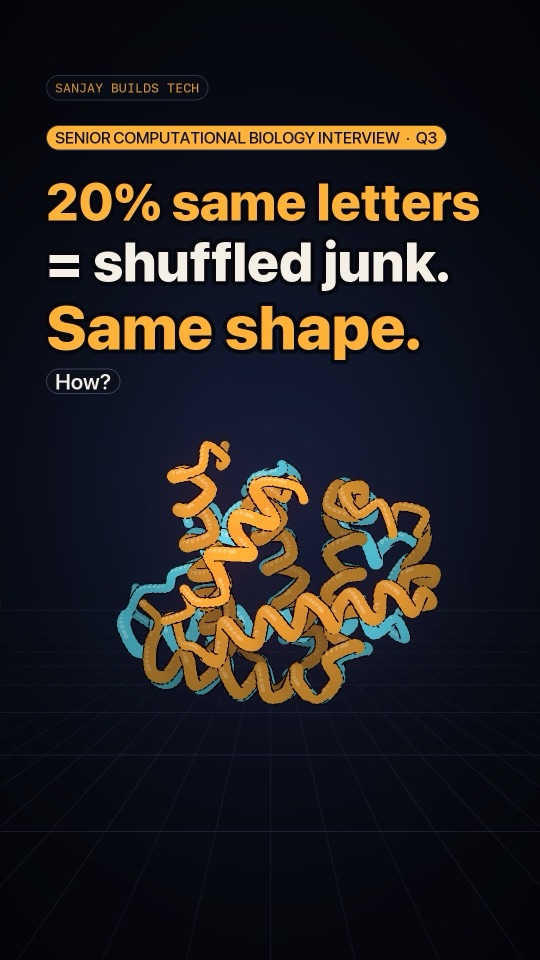
Many. A fold is not specified by one sequence: natural families share a structure with under 20% sequence identity, and design programs produce many different low-energy sequences for the same backbone. That degeneracy is what makes the problem solvable at all.
Where does machine learning fit now?
Inverse folding models (ProteinMPNN and relatives) replace the hand-built energy function: given a backbone, they output amino acids position by position, much faster and with a higher experimental success rate. Structure prediction of the AlphaFold kind is then used to check that the designed sequence folds back to the target.
Does the tag count as part of the design?
No. The Met-Gly start and the His6 purification tag are there for expression and purification, not for the fold. The designed protein is the 92 residues in between, and that is the count used for 20⁹².