Play with itMove the weight in and out
Worked solutionThree lines, in order
Find the force
The only thing the weight does is pull straight down with its weight.
Find the lever arm
Torque uses the distance from the joint to the line the force acts along, measured at a right angle to the force. The force is vertical, so the lever arm is the horizontal distance from the shoulder to the weight. How high the weight hangs does not matter.
Multiply
Check the units: newtons times metres gives newton metres. If your answer came out in kg·m, the g is missing.
Answer: B, about 42 N·m
And that is only the weight. The shoulder also has to hold up the arm itself, which is where the hook's answer comes from (next section).
So why only five kilos?The arm is its own heaviest load
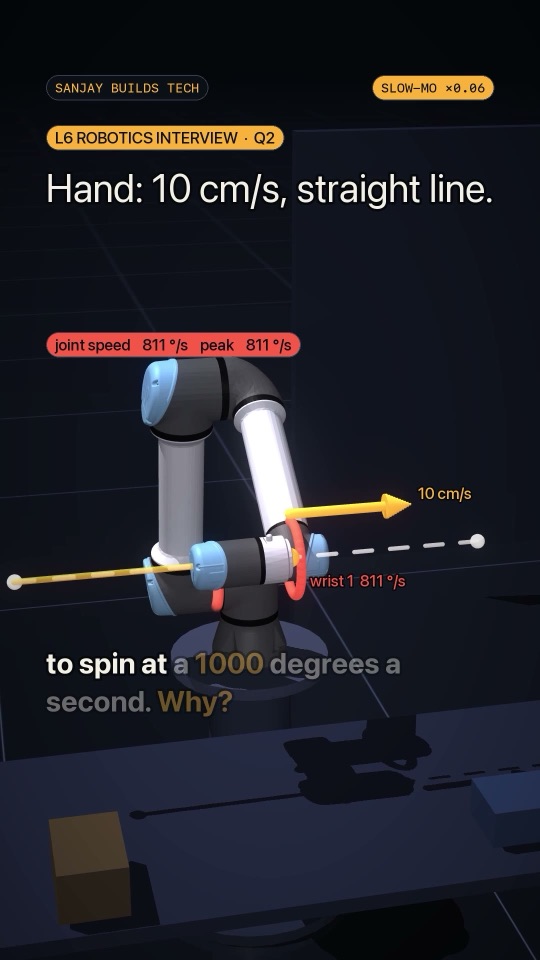
Numbers from the MuJoCo simulation in the reel (UR5e model, 21.0 kg, shoulder motor limit 150 N·m), arm stretched so the weight sits 0.85 m out:
- Shoulder motor holding still: 91 N·m.
- From the 5 kg weight: 42 N·m. From the arm's own links: 50 N·m, a third of the limit, spent before it lifts anything.
- That leaves about 59 N·m spare. Holding still is the easy case: speeding the weight up or slowing it down costs extra torque, and so does a tool on the wrist. The rating keeps that margin.
- The small wrist motors are limited to 28 N·m. A weight held off to the side of the wrist runs into that limit long before the shoulder runs into its own.
Wrong answersWhy each one is tempting
| Pick | What went wrong |
|---|---|
| A · 4 | Used the mass as if it were a force: 5 × 0.85. Missing × 9.81. |
| C · 85 | The reach in centimetres, with no force in it. |
| D · 420 | Right idea, wrong units: 49 N × 8.5 instead of 49 N × 0.85 m. |
Follow-ups an interviewer asks nextTry these before opening them
Same weight, half the reach. What happens to the torque?
It halves: 49 N × 0.425 m = 20.8 N·m. Torque from a hanging weight is proportional to reach. This is why a robot carries heavy parts tucked in close and only reaches out at the end of the move.
The arm points straight up with the weight directly above the shoulder. Torque?
Zero. The force's line passes through the joint, so the lever arm is 0. The motor does nothing while the bearings carry the full 49 N. (It is also an unstable balance: the smallest lean brings the torque back.)
The arm lifts the weight at 0.85 m with an upward acceleration of 2 m/s². Torque from the weight now?
The motor has to supply m(g + a) instead of m·g: 5 × (9.81 + 2) × 0.85 = 50.2 N·m. Fast moves are why real payload ratings sit well under the static limit.
With 150 N·m at the shoulder and 50 N·m used by the arm itself, what is the most it could hold still at 0.85 m?
(150 − 50) N·m ÷ (9.81 × 0.85 m) = 12 kg, with nothing left over for moving, and ignoring the wrist motors, which give up first. The slider above shows this number for any reach.