Worked solutionOne step at a time
Only the upward part of the thrust holds it up
Thrust T points along the drone's body. Lean by θ and the part still pointing up is T·cos θ. To hold height that part must equal the weight W.
So leaning costs thrust
Rearranged, the thrust needed grows as the lean grows. At the 24° cruise in the reel it is 14.2 N, at 45° it is 18.4 N, at 60° it is 26 N.
Set the thrust to its maximum
The steepest lean is where the motors are flat out. Put T = 52 N and solve for the angle.
Answer: C, about 75°
θ = acos 0.25 = 75.5°. Notice that only the ratio matters: a drone with four times its weight in thrust can lean to 75.5° whatever it weighs.
What the simulation showedThe simulated drone stops well short of the limit
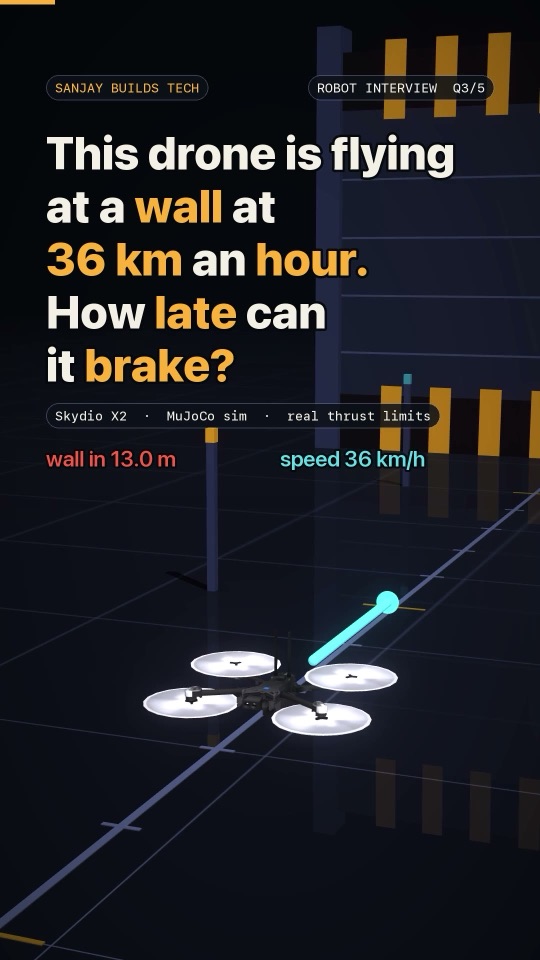
The reel flies a Skydio X2 model (1.33 kg, 13 N of weight, 52 N of thrust) in MuJoCo:
- Cruising at 32 km/h against air drag needs a 24° lean.
- In a banked circle it holds 30°, 45° and 60°, then creeps up to 68°.
- It is never flown at 75.5°. At the limit every motor is at full thrust, so there is nothing left to correct a gust or a wobble with. Real flight controllers keep that margin.
Wrong answersWhy each one is tempting
| Pick | What went wrong |
|---|---|
| A · 45° | Picked the angle that feels like a natural limit. It needs only 18.4 N. |
| B · 60° | Used cos θ = 1/2 instead of 1/4, which is the answer for a drone with twice its weight in thrust. |
| D · 90° | Assumed more thrust always helps. Sideways thrust holds nothing up. |
Follow-ups an interviewer asks nextTry these before opening them
The drone picks up a payload and now weighs 26 N. Steepest lean?
cos θ = 26 ÷ 52 = 0.5, so 60°. Doubling the weight cost 15° of lean.
How hard does it accelerate sideways at the limit?
The sideways part of the thrust is T·sin θ, which gives a = g·tan θ = 9.81 × tan 75.5° = 38 m/s², about 3.9 g.
Why would you never plan a flight at 75°?
All four motors are saturated, so the controller cannot speed any of them up to rotate or to recover from a disturbance. The drone can hold height on paper and is uncontrollable in practice.
What limits the lean in fast forward flight?
Air drag. In steady flight the sideways thrust only has to cancel drag, so the lean settles where W·tan θ equals the drag force. In the reel that is 24° at 32 km/h.