Worked solutionOne step at a time
Model the robot as an upside-down pendulum
Treat the body as a point mass at height h on a massless leg. If it is a distance x ahead of the foot, gravity tips it further ahead, and the further it is the faster it goes.
That equation has a built-in time scale
The only time you can build from g and h is √(h/g). For this robot it is about a quarter of a second: that is how quickly a fall grows.
The capture point
It is the spot where, if the foot lands there, the body coasts to a stop exactly above it. It sits ahead of the centre of mass by the speed times that time scale.
A shove changes the speed, not the position
During a short push the body has no time to move, so x is unchanged and v jumps by 1 m/s. Only the second term changes.
Answer: B, 27 cm
The mass of the robot never appeared. A heavy humanoid and a light one with the same hip height must step the same distance to catch the same change in speed.
What the simulation showedThe next steps chase the point
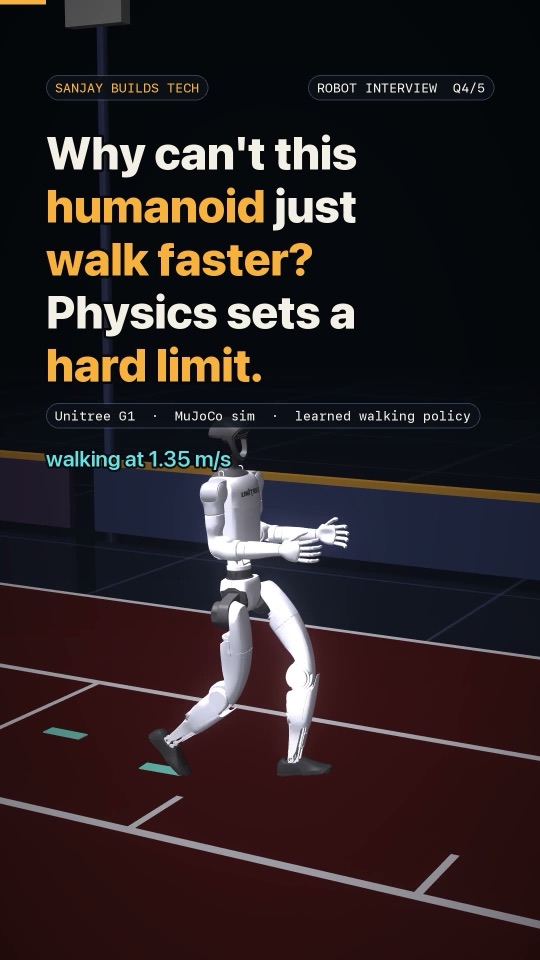
The reel runs a Unitree G1 in MuJoCo under a learned walking policy, then shoves it.
- The capture point is drawn on the floor from the measured position and velocity of the centre of mass, so it jumps the moment the shove lands.
- The policy was never told about capture points. Its next steps still land towards that spot, because that is the only place a foot can stop the fall.
- The formula treats the body as a point on a rigid leg. A real robot also swings its arms and bends at the hip, which buys it a little more room than the formula allows.
Wrong answersWhy each one is tempting
| Pick | What went wrong |
|---|---|
| A · 7 cm | Forgot the square root: 0.7 ÷ 9.81. |
| C · 70 cm | Used the height itself as the distance. |
| D · 1 m | Multiplied the speed by one second instead of by the robot's own time scale. |
Follow-ups an interviewer asks nextTry these before opening them
The same shove hits a robot whose centre of mass is 1.4 m up. How far now?
√(1.4 ÷ 9.81) = 0.378 s, so 38 cm. Twice the height is only √2 times the distance.
The robot's foot is 20 cm long. What does a 27 cm jump mean?
The capture point has left the foot it is standing on. No ankle torque can bring it back, so the robot must take a step. If the jump had been 10 cm, it could have stayed put and pushed through its ankle.
Same robot, same shove, on the Moon?
Gravity is about one sixth, so √(h/g) is √6 = 2.4 times larger and the capture point jumps 65 cm. Falling is slower there, but each shove carries you further.
Why track this point instead of the centre of mass?
The centre of mass tells you where the robot is. The capture point tells you where it is going to end up, which is what the next footstep has to answer.