Play with itPick a speed and a brake angle, then fly it
Worked solutionOne step at a time
What holds it up while it leans?
Thrust T points along the drone's body. Lean back by θ and it splits in two: T·cos θ still points up, T·sin θ points backwards. Holding height means the upward part still equals the weight.
What is left over brakes it
The backward part is the only horizontal force (ignoring air drag), so it sets the deceleration. Divide the two parts and both T and m drop out.
Constant braking: use v² = 2·a·d
Starting at v and ending at rest under constant deceleration a:
Answer: B, about 5 m
It takes v/a = 1.02 s. Notice the mass never appeared: a heavy drone and a light one stop in the same distance at the same tilt, as long as their motors can supply T = m·g / cos 45° = 1.41 × their weight.
What the simulation showedThe simulated drone needs a little more room
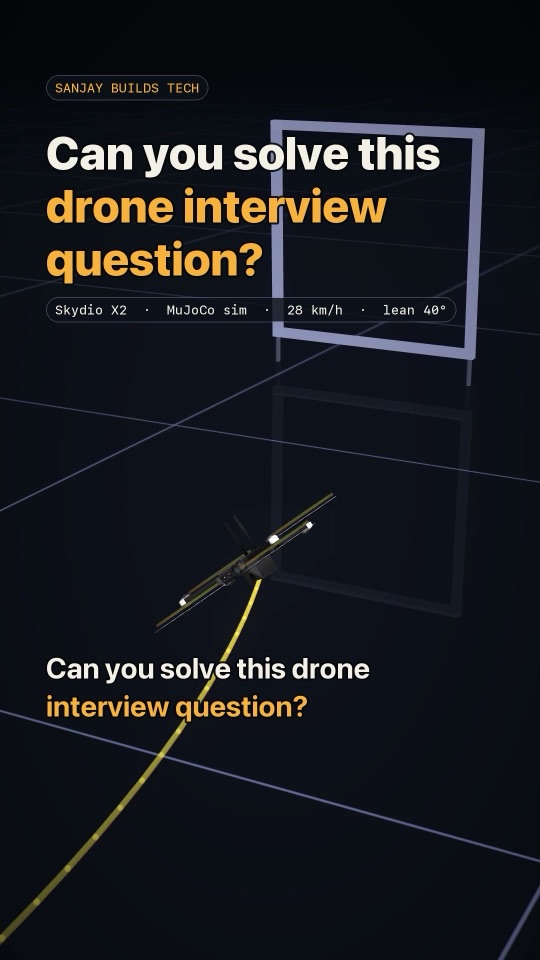
The Skydio X2 in the reel (1.33 kg, weight 13 N, motors up to 52 N) was flown at 10 m/s with air drag switched off, then told to hold a brake tilt:
| Tilt | Formula | Simulated drone |
|---|---|---|
| 15° | 19.0 m in 3.80 s | 20.0 m in 3.89 s |
| 30° | 8.8 m in 1.77 s | 9.8 m in 1.86 s |
| 45° | 5.1 m in 1.02 s | 6.3 m in 1.13 s |
- Every run stops about a metre long. The drone needs 0.16 s to rotate to its brake tilt, and for that moment it is still doing close to 10 m/s. Set the third slider to about 0.2 s and the model above lands on the same numbers.
- B is still the nearest option, and the interview answer is the ideal 5.1 m. Saying "plus about a metre for the pitch-back" is what gets you the job.
- Holding height at 45° needs 18.4 N of thrust, 1.41 × the weight and only 35% of what the motors can give. The simulated run peaked at 26 N while it was rotating.
Wrong answersWhy each one is tempting
| Pick | What went wrong |
|---|---|
| A · 2.5 | Forgot that half the tilted thrust is holding the drone up; or halved the answer twice. |
| C · 10 | Speed × time, with the full speed instead of the average speed. |
| D · 20 | Used far too little braking, about a quarter of g. |
Follow-ups an interviewer asks nextTry these before opening them
You double the speed to 20 m/s. Stopping distance?
Four times as far: 20.4 m. Distance grows with the square of speed, the same reason a car at 100 km/h needs four times the road of one at 50.
What is the hardest this drone could possibly brake while holding height?
It runs out of thrust when m·g / cos θ reaches the motors' maximum. With thrust up to 4× its weight, cos θ = 1/4, so θ = 75.5° and a = g·tan 75.5° = 3.9 g. Set the slider to 75° to see how short that is. Real drones leave margin for control.
Why does the real drone travel further than the formula says?
It cannot jump to 45° instantly. While it is still rotating it is still moving at nearly full speed. Every 0.1 s of pitch-back delay at 10 m/s adds roughly half a metre to a metre. Try the third slider.
Would it stop shorter if it stopped holding height?
Yes. Tilt to 90° with full thrust and all of it brakes, but nothing holds the drone up, so it falls while it stops. Racing pilots trade height for braking exactly like this; a delivery drone near the ground cannot.