Worked solutionOne step at a time
Lift is not the problem
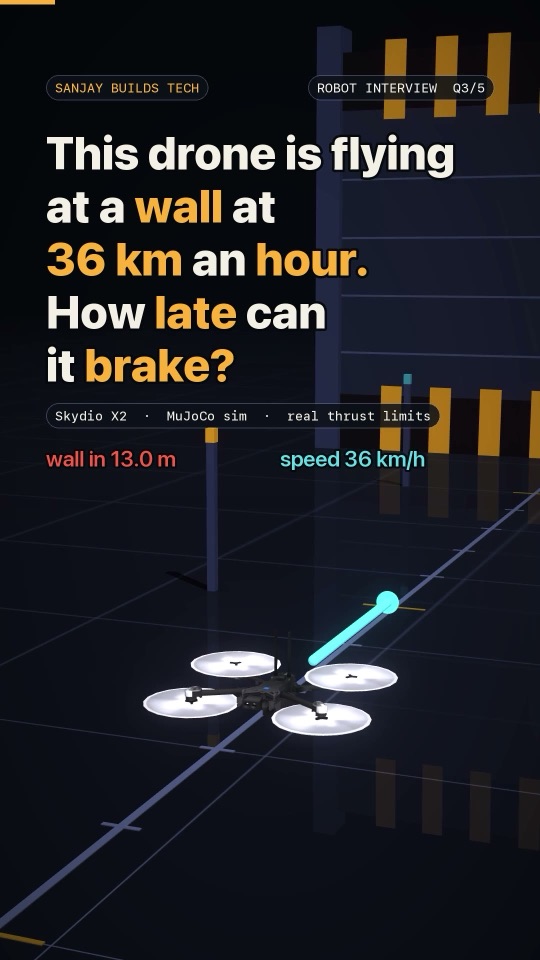
The model's motors each give up to 13 N. Three of them give 39 N against a weight of 1.325 kg × 9.81 = 13.0 N.
Every propeller also twists the body
Spinning a propeller pushes back on the motor, so the body feels a twist of 0.0201 N·m for every newton of thrust. Motors 1 and 3 twist one way, 2 and 4 the other. In a hover each gives 3.25 N, so the four twists of 0.065 N·m cancel.
Lose motor 4 and stay level
Zero roll torque and zero pitch torque with motors 1, 2 and 3 have one solution: motor 2 off and the diagonal pair at 6.5 N each. That pair spins the same way, so their twists add.
Four demands, three motors
Thrust, roll, pitch and twist are four equations; three motor forces can only meet three. Something has to go, and the cheapest one to lose is the heading: a drone does not need to face any particular way to hover.
Answer: B, yaw
The controller gives up yaw. It lets the body spin and controls only the direction of the thrust axis and the height (Mueller and D'Andrea, 2014). The spin climbs until air drag on the spinning body matches the 0.26 N·m twist; in this model that is about 5.6 turns a second.
What the simulation showedTwo controllers, same failure
The reel flies the Skydio X2 from MuJoCo Menagerie as shipped (mass, 13 N motors, twist coefficient, the model's own air drag) at 500 Hz, and stops motor 4 after 1.5 s of hover.
- The old 4-motor controller keeps asking for zero twist. It cannot get it, tips past 45° and hits the floor 0.68 s after the failure.
- The thrust-axis controller uses motors 1–3 for height, roll and pitch only. Right after the failure it commands 6.5 N, 0 N and 6.5 N, the net twist is 0.26 N·m, and the body starts to spin.
- The spin settles at about 5.6 turns a second, where the model's air drag on the body (0.27 N·m) matches the twist. Motor 2 averages 0.25 N, close to idle. The height stays within 2.9 cm, and the drone drifts at most 0.45 m sideways.
Wrong answersWhy each one is tempting
| Pick | What went wrong |
|---|---|
| A · altitude | Thought losing a motor means losing lift. There is 3× the thrust it needs. |
| C · roll | Roll and pitch point the thrust. They are the axes it cannot do without. |
| D · nothing | Counted thrust only. The twist is a fourth equation that three motors cannot also satisfy. |
Follow-ups an interviewer asks nextTry these before opening them
What sets the final spin rate?
The balance between the unbalanced propeller twist and the drag torque that resists spinning. Drag grows with the square of the spin rate, so the rate settles where the two match. On a real drone the propellers add their own drag, so the number depends on the vehicle; 5.6 turns a second is what this model's air drag gives.
Why does motor 2 end up nearly idle?
With motor 4 gone, the only way to balance roll and pitch about the centre is to load the diagonal pair equally. Motor 2 sits on the other diagonal, so any thrust from it creates a torque nothing can cancel. The controller only uses it in short bursts to correct the tilt.
The drone is spinning. How does it still fly to a point?
It tilts the spinning thrust axis toward where it wants to go. The heading changes all the time, but the thrust direction is what moves the drone, so the controller works with that axis alone and ignores the heading.
Can a hexacopter lose a motor without spinning?
Usually yes. With six motors there are more forces than the four demands (thrust, roll, pitch, twist), so the rest can be rebalanced to cancel the twist, as long as none of them saturates.